
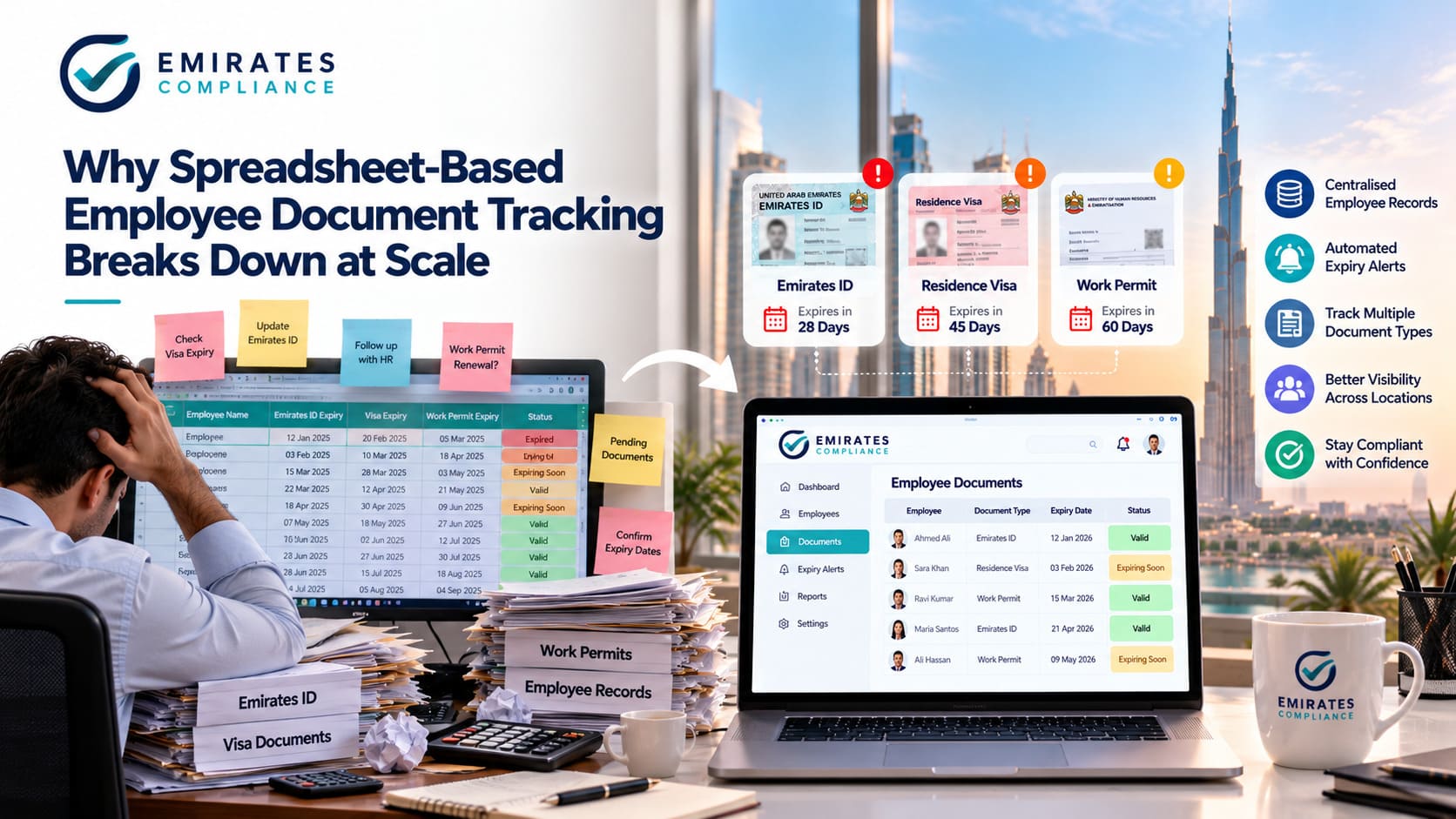
Managing employee documents may seem straightforward when a business has a small workforce. HR teams can maintain a spreadsheet containing employee names, Emirates ID numbers, visa expiry dates, work permit details and renewal information. However, as companies expand and employee numbers increase, this manual approach becomes increasingly difficult to manage. What initially works for 20 employees may become a major administrative challenge when managing 500 or 5,000 workers across multiple locations.
For UAE businesses, employee document tracking is particularly important because workforce records often include Emirates IDs, residence visas, work permits, passports and professional certificates. At Emirates Compliance, we understand that growing businesses need more than spreadsheets to maintain accurate employee records, monitor expiry dates and manage workforce documentation efficiently.
1. Spreadsheets Become Difficult to Maintain as Workforces Grow
A spreadsheet may be manageable when HR teams are responsible for a limited number of employees. However, larger organisations experience frequent workforce changes, including new joiners, employee transfers, resignations and document renewals.
Each change requires someone to update the relevant records manually. When hundreds of updates are made across different files, the risk of outdated or inconsistent information increases.
For companies operating in construction, security, facilities management and labour supply, employee document management in the UAE becomes even more challenging because workers may be assigned to different projects or locations.
2. Important Document Expiry Dates Can Be Overlooked
One of the biggest weaknesses of manual document tracking is the absence of reliable automated reminders.
HR teams may record Emirates ID, visa and work permit expiry dates in spreadsheets, but they still need to check those records regularly to identify upcoming renewals.
If the responsible employee is unavailable or the spreadsheet is not reviewed on time, important expiry dates may be missed.
An automated employee document expiry tracking system can help businesses identify upcoming expiries earlier and provide HR teams with sufficient time to coordinate renewals.
3. Multiple Spreadsheet Versions Create Confusion
As businesses expand, different departments often begin maintaining their own employee records. HR may manage visa information, operations may track employee assignments, and administrative teams may maintain work permit details.
When these records are stored in separate spreadsheets, employees may appear with different information across multiple files.
This makes it difficult to determine which record is accurate and whether a document has already been renewed.
A centralised employee document management system helps maintain consistent information by connecting relevant documents and expiry dates to individual employee profiles.
4. Manual Tracking Increases Administrative Work
Spreadsheet-based tracking requires continuous manual effort. HR teams must review expiry dates, contact employees, follow up with managers, update records and verify completed renewals.
These activities become repetitive when businesses manage hundreds or thousands of employees.
Instead of focusing on workforce planning and employee support, HR professionals may spend significant time searching through spreadsheets and checking document statuses.
Using HR document management software in the UAE can reduce repetitive tracking tasks and provide better visibility into upcoming document requirements.
5. Tracking Renewal Progress Becomes Complicated
Knowing when a document expires is only part of the challenge. HR teams also need to understand whether the renewal process has started, which documents are pending and who is responsible for the next action.
Spreadsheets may contain expiry dates but often lack a consistent way to manage renewal progress.
For example, one employee's residence visa renewal may be awaiting documentation, while another employee's work permit update may require internal follow-up.
A structured document renewal tracking system can help teams monitor these stages and maintain clearer accountability throughout the process.
6. Limited Visibility Across Multiple Locations
Businesses operating across multiple UAE locations need reliable access to workforce information.
When employee documents are managed through local spreadsheets, head-office HR teams may struggle to obtain a complete view of document validity across the organisation.
This is especially relevant for companies with site-based employees, rotating workforces and frequent transfers.
A connected workforce compliance management system can provide centralised visibility while helping teams identify document-related issues across different locations.
Moving Beyond Spreadsheets With Emirates Compliance
Spreadsheets are useful for basic recordkeeping, but they are not always suitable for managing the documentation requirements of a growing workforce. As employee numbers increase, businesses need a more structured approach to tracking expiry dates, maintaining accurate records and monitoring renewals.
At Emirates Compliance, we help UAE businesses move beyond disconnected spreadsheets through centralised employee records, document management and automated expiry alerts. Our platform supports better visibility into workforce documentation, helping HR teams identify upcoming expiries and maintain organised employee information.
Whether your organisation manages 100 employees or several thousand workers, adopting a more connected approach to employee document tracking in the UAE can reduce administrative complexity and support more proactive workforce compliance.