For businesses operating in the UAE, payroll is more than calculating salaries at the end of each month. Companies covered by the UAE Wage Protection System (WPS) need to process employee wages through an established framework that allows salary payments to be recorded and monitored. One of the most important elements within this process is the Salary Information File, commonly known as a SIF file. At Emirates Compliance, we work with businesses managing large and distributed workforces, where preparing accurate payroll information can quickly become complicated. Understanding what a SIF file is, why it matters and how it fits into WPS payroll can help HR and payroll teams build a more organised salary-processing workflow.
What Is a SIF File in the UAE?
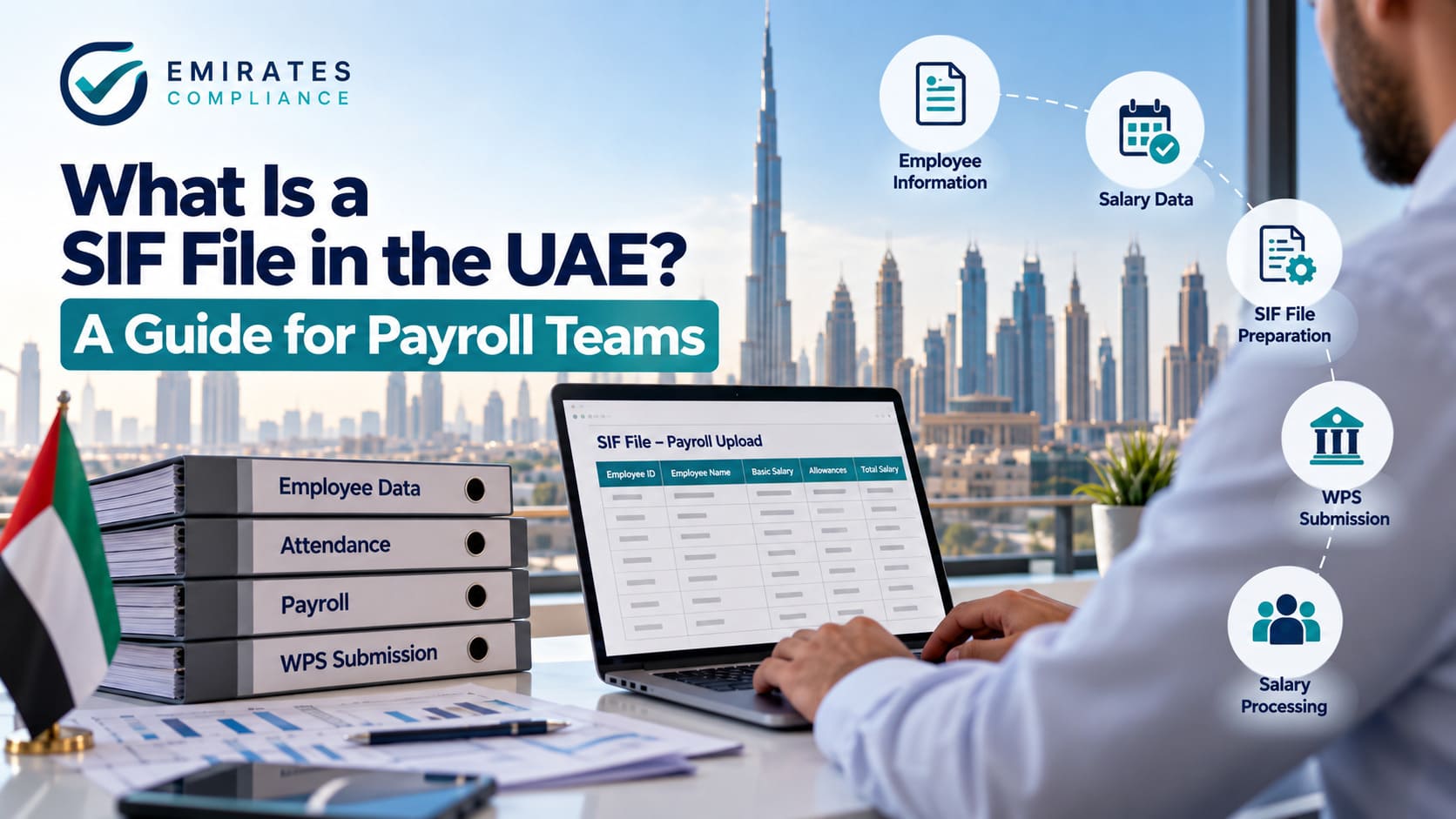
A SIF file in the UAE is a Salary Information File used within the Wage Protection System to communicate salary information for employees. The Central Bank of the UAE specifically refers to Salary Information Files being uploaded to and accepted by WPS, while its regulations also require relevant payment service providers to educate employers about the required SIF format and associated regulatory procedures. Rulebook Rather than viewing the SIF as just another payroll document, businesses should see it as a structured part of the salary-payment process. The accuracy of the information used to prepare the file is therefore important, particularly for organisations processing payroll for hundreds or thousands of employees.
How Does a SIF File Work With WPS?
The UAE Wage Protection System was implemented by the Central Bank in 2009 to provide a secure and efficient mechanism for timely wage payments and to enable labour authorities to monitor employer wage payments. Information moves from employers through contracted wage-payment agents, while WPS provides salary information required for processing employee payments. Central Bank of the UAE The SIF forms part of this process by providing structured salary information for a payroll cycle. Once payroll has been finalised, the required salary information is prepared in the appropriate format and submitted through the employer's WPS payment channel. This is why SIF preparation should not be treated as an isolated finance task—it depends on accurate workforce and payroll data being available beforehand.
Why SIF Accuracy Matters for Payroll Teams
A payroll calculation may be correct internally, but errors in the information used to generate a WPS SIF file can still create unnecessary processing issues. Employee records may change during the month, workers may join or leave, attendance and overtime may need approval, and salary adjustments may need to be reflected before payroll is finalised. When HR, operations and payroll teams maintain separate spreadsheets, these changes can easily be missed. For larger employers, the challenge increases because one incorrect workflow can affect multiple employee records. We therefore recommend treating payroll validation as an ongoing process rather than leaving all checks until the SIF is ready for submission.
Common SIF File Problems Businesses Should Avoid
Many SIF file errors begin with inconsistent workforce information. Outdated employee records, incorrect salary details, incomplete payroll adjustments and differences between HR and payroll data can all create problems before submission. Attendance can be another source of discrepancies, particularly for construction, facilities management, security, logistics and labour-supply businesses operating across multiple locations. Payroll teams should establish a clear review process that verifies employee status, attendance, overtime, leave, salary adjustments and other relevant payroll information before generating the final file. Keeping an approval history also gives teams a clearer audit trail when they need to investigate a salary difference.
Moving From Manual SIF Preparation to a Connected Payroll Process
Spreadsheets can support payroll when employee numbers are relatively small, but managing a large workforce through disconnected files introduces additional administrative work. HR may maintain employee information in one spreadsheet, operations may record attendance elsewhere, and payroll may then manually combine both sources before preparing the Salary Information File. A connected workforce management process reduces this fragmentation by keeping employee, attendance and payroll-related information within a more consistent workflow. It also gives payroll teams an opportunity to identify discrepancies earlier instead of discovering them during final WPS processing.
How Emirates Compliance Supports Better Payroll Management
At Emirates Compliance, we believe accurate SIF preparation starts long before the file itself is generated. Our platform helps UAE businesses bring employee records, attendance, workforce information and payroll workflows into a connected environment, giving HR and payroll teams greater visibility throughout the salary-processing cycle. For businesses managing large or distributed teams, this means fewer disconnected processes and a clearer path from workforce data to WPS payroll processing. By improving the information behind every payroll cycle, businesses can make SIF preparation more organised, consistent and manageable.